Argentine ant colony suppression in San Diego addresses an invasive, multi-queen species (Linepithema humile) that forms continuous subterranean networks across urban coastal soils. Standard baseboard spraying triggers…
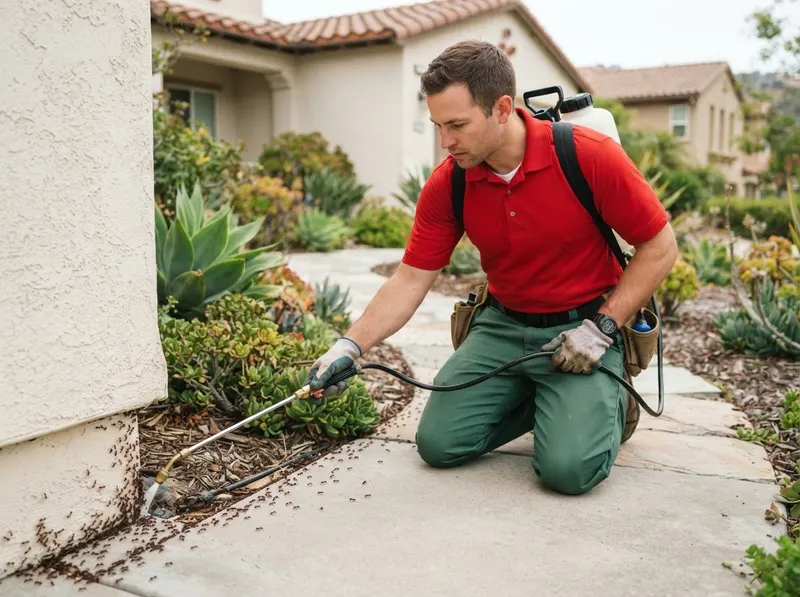
Argentine ant colony suppression in San Diego addresses an invasive, multi-queen species (Linepithema humile) that forms continuous subterranean networks across urban coastal soils. Standard baseboard spraying triggers bud initiation, a defense mechanism where worker ants split away to form additional satellite colonies containing viable queens. Effective treatment relies on low-dose non-repellent active ingredients and slow-acting borate or fipronil-based baits that workers carry back to queens and developing larvae. Field guidance from the UC Statewide Integrated Pest Management Program documents that synthetic pyrethroid perimeter sprays fail against Argentine supercolonies while increasing runoff hazards in local municipal storm drains. Technical application standards registered through the United States Environmental Protection Agency emphasize placing targeted bait formulations along trailing guidelines rather than drenching baseboards.
Soil hydration patterns across San Diego County heavily influence structural ant pressure. During hot summer months and sudden coastal heatwaves, massive ant trails move directly from desiccated exterior topsoils into residential interiors seeking water lines, pet dishes, and plumbing penetrations. Properties in canyon-adjacent zones such as Clairemont and Mission Valley experience sustained foraging trails moving from riparian brush directly into stucco weep screeds. Moisture management guidelines published by the City of San Diego Stormwater Department stress eliminating structural moisture pools to reduce insect vectors and preserve local waterways. Certified applicators credentialed by the California Structural Pest Control Board inspect expansion joints, subfloor stem walls, and irrigation perimeters before applying targeted micro-barriers, avoiding broad-spectrum disruption to native beneficial garden predators.
1. Technicians identify active entry paths along foundation stems, window sills, and weep screeds using moisture meters and hand inspection tools.
2. Slow-acting non-repellent liquid bait stations and subterranean dispensers are installed around exterior foraging routes to facilitate bait transfer to subterranean queens.
3. Exterior structural perimeter cracks and landscape-to-foundation bridges are treated with micro-targeted, watershed-conscious barrier formulations that comply with standards from the California Department of Pesticide Regulation.
4. Technicians assess drip-line irrigation heads, sub-slab plumbing lines, and crawlspace relative humidity to eliminate water reservoirs that sustain satellite nesting.
Residential landscapes bordering preserved natural open spaces in La Jolla, Ocean Beach, Point Loma, and North Park encounter distinct multi-queen dynamics due to expansive unmanaged soils. Research shared by the UC Riverside Department of Entomology reveals that the Southern California coastal supercolony lacks intraspecific territorial aggression, meaning colonies merge across property lines rather than fighting. Preserving native soil structure aligns with conservation objectives outlined by the California Department of Fish and Wildlife and habitat monitoring frameworks from the U.S. Fish and Wildlife Service. Structural guidance from the National Pest Management Association emphasizes treating foraging entry points rather than interior surfaces, ensuring family spaces and domestic pets remain unexposed while worker populations deliver suppression agents directly to central reproductive chambers.
Every job gets a firm, written price after a free on-site visit.
For standards, safe disposal, and service guidance on pest control services in San Diego, CA, useful references include U.S. EPA, ENERGY STAR, U.S. Dept. of Energy, Consumer.gov, U.S. Census Bureau, and Google Maps. General consumer and small-business resources are available from USA.gov, Better Business Bureau, FTC Consumer Advice, U.S. Small Business Administration, and Ready.gov.
Tell us about your argentine ant colony suppression job in San Diego and we'll send a clear, written quote, usually the same day.
 Greenway Insect Control